 Bible Prayer
How to Start a Prayer Journal
A prayer journal is the simplest tool most people never try: a place to write down what you prayed, what you're grateful for, and what you're waiting on. It takes five minutes a day, and months later it becomes something remarkable — a written record of God's faithfulness in your actual life.
Why write your prayers down?
- It slows you down. Writing forces you to say one true thing at a time instead of letting worry spin in circles.
- It keeps you focused. A wandering mind has somewhere to return to — the page.
- It makes answered prayer visible. We forget what we asked for. A journal doesn't. Few things build faith like reading a six-month-old request that has since been answered.
- It gives grief and gratitude a place to go. Some things are easier written than spoken.
What you need (less than you think)
Any notebook works. So does a private app. The right choice is whichever one you'll actually reach for every day. If you use your phone in the morning anyway, an app meets you where you already are — just make sure it's genuinely private. (The Bible Prayer app's journal keeps every entry on your device: no account, no cloud, works offline.)
The simple 4-part entry
Don't overthink the format. This takes five minutes:
- Date. Future-you will want it.
- Verse. Copy one line of Scripture from today's reading or prayer.
- A few honest sentences. What's actually going on — "Worried about the meeting Thursday. Tired. Grateful the kids laughed at dinner."
- One request. Specific enough that you'll recognise the answer: not "bless my family" but "help Sam settle into the new school."
15 prompts for days when the page stays blank
- What am I most grateful for today, specifically?
- What am I carrying that I haven't said out loud?
- Where did I see a small mercy today?
- What would I ask God for if I believed He was listening closely?
- Who needs my prayers more than I do today?
- What am I afraid of this week — and what does Scripture say to it?
- What do I need to confess and let go of?
- Which verse has followed me around lately? Why?
- What prayer from last month has been answered — fully, partly, or differently than I hoped?
- What decision do I need wisdom for?
- Write a one-sentence prayer for each member of your household.
- What season is my faith in right now — spring, summer, autumn, winter?
- What would "be still" (Psalm 46:10) look like in my life this week?
- Where have I been trying to control what I should entrust?
- What do I want to remember about today in a year?
When you miss days — and you will
Missing days is part of every real journaling life. Don't backfill, don't apologise to the notebook, don't start over from scratch. Just date a new page and write today's entry. A journal with gaps that continues for years is worth infinitely more than a perfect week that ends in guilt. Grace applies here too.
Look back on purpose
Once a month, reread a few old entries. Mark answered prayers. Notice the worries that dissolved on their own. This is the quiet payoff of the whole practice: evidence, in your own handwriting, that you were heard. It pairs beautifully with a structured season of prayer — try the 21-day prayer challenge with a one-line journal entry each day.
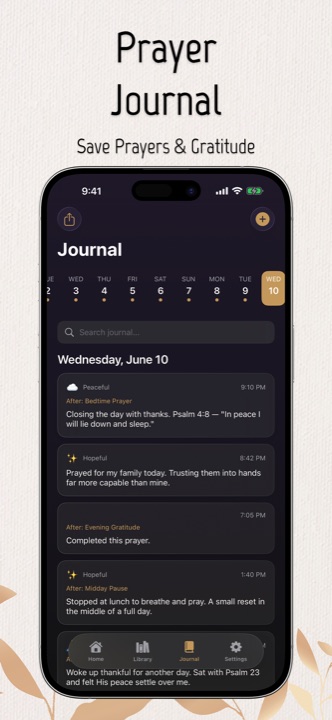
A private journal, built into your prayer time
Write reflections after each guided prayer — saved on your device, never uploaded. Free, no account.
Download Bible Prayer FreeFrequently asked questions
What do you write in a prayer journal?
Keep it simple: the date, a verse, a few honest sentences, and one specific request. Over time add gratitude lists, answered prayers and reflections.
How do I start journaling prayers?
Attach it to prayer you already do: after you pray, write two or three sentences. Aim for most days, not perfect days.
Is a prayer journal app private?
It depends on the app. Bible Prayer keeps entries on your device — no account, no cloud upload, works offline — so your honest words stay yours.